


This is a record of the first yarn that happened along the Murray River in Robinvale. The researcher brought the artwork that was produced in response to the earliest stage of the Boorai Dreaming Project, coming into being as a physical and emotional reaction to women’s stories of loss and oppression, backed up by the Bringing Them Home Report, (HRCBTHR, 1997).
It was a Possum Mama Story that had begun the research momentum. The researcher was joining with the voice, heard in Melbourne’s outer western suburbs and through reading Atkinson’s Trauma Trails along with her other studies (2002; 2003). Digesting Olivers’ words of “Genocide has triggered a trauma phenomenon that infiltrates the psychic dimensions of mind, body and spirit as a social construct” (2004). These perspectives laboring home the point of the damaging effect of colonisation in the imposed ‘one nation state’ of Australia, a country in denial of its past, and ill-equipped to deal with the present state of trauma it has perpetrated.
The Lowitja Institute Seeding Grant supported the second stage of the research by funding the engagement with the River and Bush Women of Mildura and Robinvale. This stage reinforced the importance of storytelling, triggering the production of artwork for Assimilation, the Story Continues (digital story). During this time of art production, the researcher learned the functions of Photoshop freehand paint, her mind at times crashing against the lack of knowledge of digital software and the lack of digital painting skill.
Ever listening, with mind, ear, heart, and spirit for a lead into a distinctive Indigenous Research Methodology (IRM), described by Dudgeon et al., as of “critical importance in facilitating, acknowledging, validating and articulating Indigenous knowledge and experiences to strengthen individual, family and community social and emotional wellbeing (SEWB)” (2020).
And then I met the beautiful River and Bush Women of Mildura and Robinvale at Aunty Thelma's office in Robinvale. I played them the early stages of Assimiliation the Story Continues video. Their focus was heartening. Their kindness toward my nervous presentation will never be forgotten. Guiding me with the artwork, requesting additions and noting the powerful nature of the truth held in the work, “The eyes of the child trapped in the laundry with the nun, those eyes, I can’t stop looking at the eyes”.
The following are the images that I shared at this meeting.
Meeting the Women of Mildura and Robinvale - Through a Lowitja Institute Seeding Grant

Leaving Out of Home Care © McNally 2022
Stolen Child - The Lived Reality © McNally 2022
Premier%20procopy222.png)
.png)

Genocide Disguised © McNally 2022


Ancestors Guiding- © McNally 2022
Forced Intergenerational Removal - Genocide © McNally 2022
Blak Madonna - Healing Archetype © McNally 2022
Nurture Memory - Moving Through Millennia © McNally 2022
next%20edit%20(2)proud%20woman%20(27)final%20edit.png)
The Australia Illusion © McNally 2022
Red Ochre - Bloodlines & Yarns
Red Ochre is used symbolically to represent blood lines and the impact of genocide on family systems. Starting as first century hunting parties and mass murder and continuing as the Stolen Generations from 1910 onward, colonial control is currently projected through child protection practices. Aboriginal family systems carry the injury of the past into their present experience of survival, as the children continue to be incarcerated in the out of home care system, and for many the juvenile justice system.
Red Ochre is used as parallel process to story Women’s Business and our blood lines that flow through our children’s bodies, from Ancestor to Grandmother, to granddaughter and daughter. Red Ochre forms a research map as the researcher entered country, through the culture of the women of this study. Their bloodlines encompassing community history embedded in the healing leaders storying and the storying of the participants who yarned with the researcher.
The yarns are charted on the research map during four stages. Each stage is depicted through interpretive arts that includes digital art and oil paintings that developed into digital stories. This includes how the researcher interpreted what was said in the yarns. At each stage the researcher asked “Did I get this right?”, “What do you think is missing?”, “Should I keep this theme or do you want it to change to something else?”
Yarning, interpretive arts, and collaboration in a cycle that began with listening, and goes forward as a statement of Community, owned and controlled.

Red Ochre Dyed Cloth and Ochre Dyed Gumnuts © McNally 2024


White Ochre - Sorry Business
White Ochre to symbolise the Sorry Business of those who take their life in response to the lived oppression they experience. Forced child removal is the gateway to The Gap (LICTGR, 2024), where lived Aboriginal disadvantage has been recorded since 2007 in response to the Bringing them Home Report, (HRCBTHR, 1997). The Gap is maintained through an unrelenting assimilation agenda, as oppression that impacts the body, mind, and spirit individually and collectively, shortening lifespans through health conditions, mental health conditions, self-medicating and misuse of substances, incarceration, family violence, homelessness, and the removal of this generation of children who carry the trauma of their family as the Stolen Generations continue.
White Ochre symbolises the beloved Elders who have passed, living and dying in the fight for justice for Peoples. White Ochre in memory of the fallen, the famous, for mob; White Ochre for the child, the young person, and the adult suicides as we raise tribal voices to continue the resistance.
Evaluation
103 women moved through the healing experiences in Mildura and Robinvale. 25 women were interviewed using the Boorai Dreaming Project pictorial evaluation model. The questions were designed to be gentle as they followed the themes of Flesh and Ephemeral through five points of reference for each category.
The results for Mildura and Robinvale are housed in the Blak Matriarchy Turnaround Time Digital Story and above. The results answer the different points of enquiry. The experience of the evaluation was overwhelmingly stated as positive, some feedback was that the art was powerful and healing, that it was a good experience, and something new.
Full description of the evaluation model and findings will be published in the research thesis when it is marked by the examiners and published by Moondani Balluk Academic Unit Victoria University in the coming months.
Black Matriarchy Turnaround Time © McNally 2024
Data from Mildura Gathering 2024
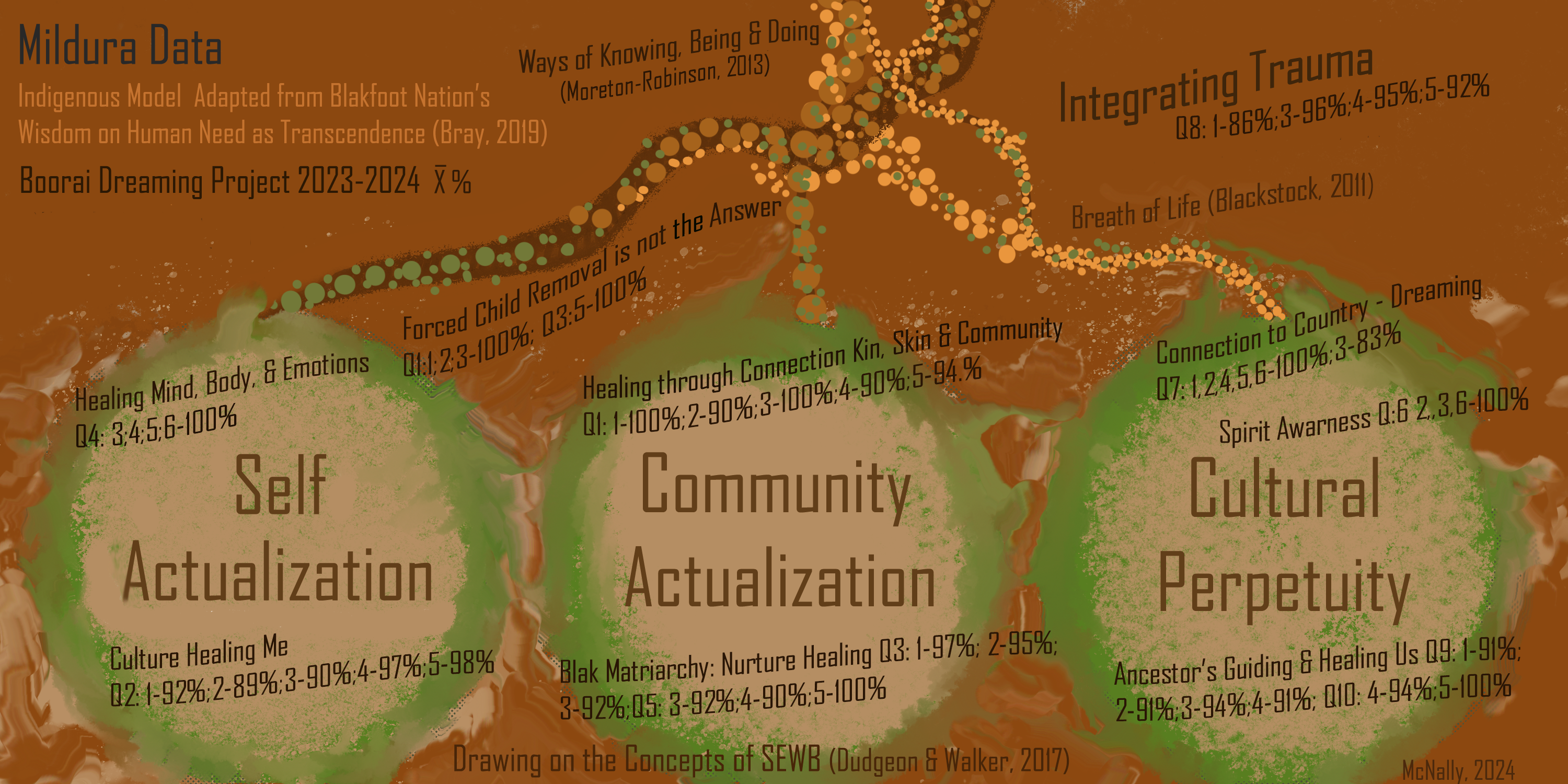
7 Participants out of 103 Women Participating in Elder Led Healing Experiences. Self-scored as Mean (Averages) of 0-100%
Data from Robinvale Healing Retreat 2024
Yellow Ochre -Research Findings
Yellow Ochre symbolises women’s healing structures, the Boorai Dreaming Project draws on understandings shared by the women whilst protecting their Intellectual Property. There is more to come in this section when the thesis is examined and a comprehensive discussion of the findings is published.
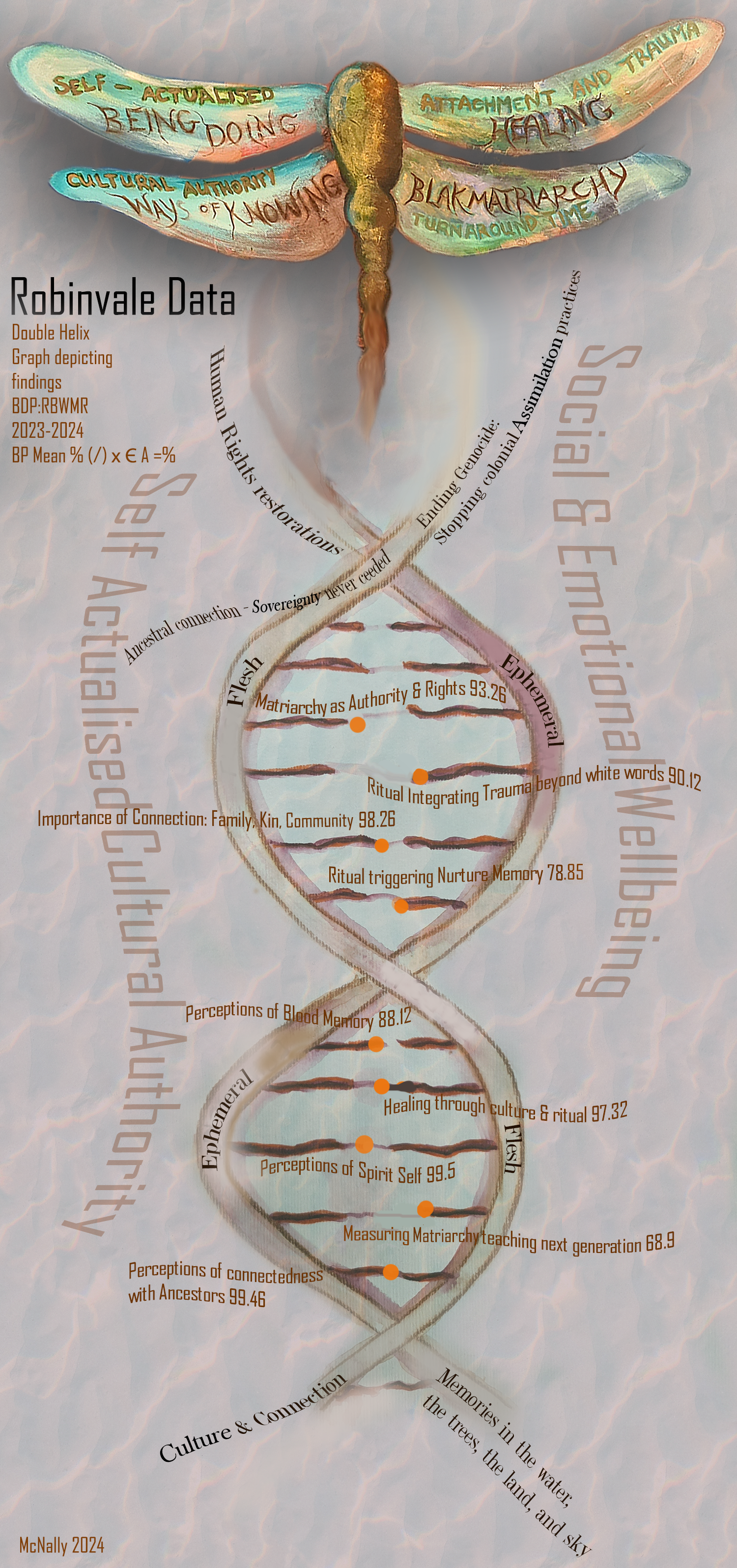
18 Participants out of 103 Women Participating in Elder Led Healing Experiences.
Self-scored as Mean (Averages) 0-100 %
.png)
Storying the experiences of the healing structures the women leaders created in Mildura and Robinvale. Blak Matriarchy Turnaround Time emerging as the flesh and the ephemeral. The spiritual nature of Aboriginality is explored through the elements of Social and Emotional Wellbeing (Dudgeon and Walker 2015). Analyzed in depth as the relationship to land, as the flesh of country, culture, family, and Kin, in balance with the ephemeral as Ancestor spirit, Ancestral landscapes, Ancestors whispering; the onto-logic, the metaphysical, the relationality (Moreton Robinson, 2017), structuring the emancipatory. A consciousness both centric and expansive, running parallel to the seen as the unseen, the unknown as the knowable, intertwined and alive within the experience of healing. Memories in the waters, the trees, the landscapes, and the sky; ways of knowing, being, and doing (Moreton-Robinson, 2013),

All these white policies and strategies have caused untold injury to our social and emotional wellbeing, and yet they have failed in their attempts to break the connection we have to the flesh and the ephemeral; it is a remembering, a reclaiming of healing (Sharman, 2023).
This is the pathway to the children finally coming home as Blak Matriarchy (and Grandfather) are appropriately resourced to deliver grassroots community-owned and controlled healing. No more child protection control, no more talk of reconciliation, we demand action. “These kids need their nanas” (Aunty Jemmes Handy, 2022)
Kids Need to Heal on Country with People who Care About Them © McNally 2024


Carrying the Weight of Intergenerational Trauma
© McNally 2024
%20(1)_edited.png)
Blak Madonna © McNally 2024

Grandmother fighting for our rights, in this generation and the one preceding and beyond. White structures perpetrating genocide, estranging the children from family and culture. Multiple foster homes, out of home care in group homes, critical levels of trauma, children left spinning in trauma as years of loss and longing continue into adolescence, as self-harm and risk taking behaviours escalate towards the juvenile justice system.
Blak Matriarchy Through the Years -Blak Matriarchy is the Remedy

Brokenhearted - Emotions Frozen in Time ©McNally 2024

Truth Telling and Justice ©McNally 2024

Families On the Run ©McNally 2024
Blak Madonna Still Fighting For Our Children © McNally 2024
Racisim Stole My Nana and Now It's Stealing My Kids
© McNally 2024
.png)
The River and Bush Women and the researcher applied for the Lowitja Institute Big Grant to record healing in the Mildura and Robinvale areas. The focus of the research in Stage Three was to record grassroots community-owned and controlled healing on Country. Assimilation the Story Continues digital story was completed with a gallery of Blak Matriarcy pictures attached. We were successful with our Grant application. The researcher yarned with the women over two months as they explored the process they wanted to follow. Ideas were rising to the surface as the women unpacked their designs for the healing structures as these rhythmic experiences of cultural healing emerged. The researcher was invited into some of these experiences, others were protected as sacred knowledge. Through yarning, a depiction of the healing being recorded was agreed to.
Lowitja Big Grant
Interpretive Arts
I brought back interpretive art through a giant oil painting poster of protest, incorporating the requests from the River and Bush Women of Mildura and Robinvale that had transpired in the first yarn. The painting without a frame was laid down on a boat ramp in Robinvale. The feedback was positive, the relationship building had its own momentum.
The painting was then stretched and travelled up to the Murray where it stayed for six weeks on display at Hands up Malley in Mildura.
After the second yarn the researcher phoned the women: “Hey do you want to apply for a Lowitja Big Grant and do healing and I can record how it goes?”;
“Yes, we want that”;
“Your Ancestors are up there talking to my Ancestors, this is just what we need”.
